

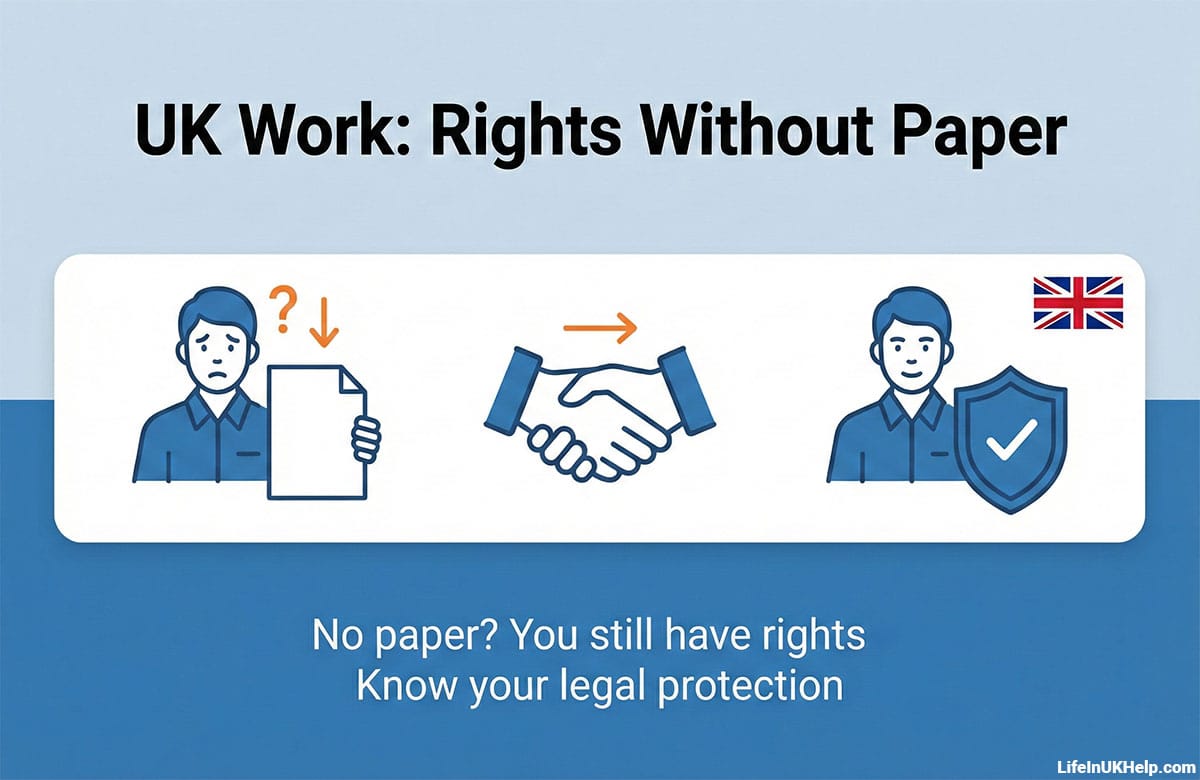
Introduction
Starting a new job is exciting, but it can be worrying if your employer does not give you any paperwork. You might be unsure if you are officially employed or if you will be paid correctly. Many people especially those reading our “Navigating Living in the UK for Beginners” guide, find themselves working in the UK without a contract and do not know if this is allowed.
This situation is very common in hospitality, construction and small businesses. If you are in this position, you might feel vulnerable. You might worry that you have no rights or that you could be fired at any moment without notice.
This article explains the rules simply. It is for anyone working in the UK without written contract paperwork and want to know their legal standing. We will cover your rights, the risks and the steps you should take to protect yourself.
Why People Search for This Topic
People search for this topic because they feel unsafe in their jobs. Usually they have been working for a few weeks or months but the boss keeps making excuses about the paperwork.
They typically worry about:
- Is it illegal to work without a contract UK?
- Will I get holiday pay or sick pay?
- Can the boss change my hours or pay whenever they want?
- How can I prove I work here if there is a dispute?
Short and Clear Answer
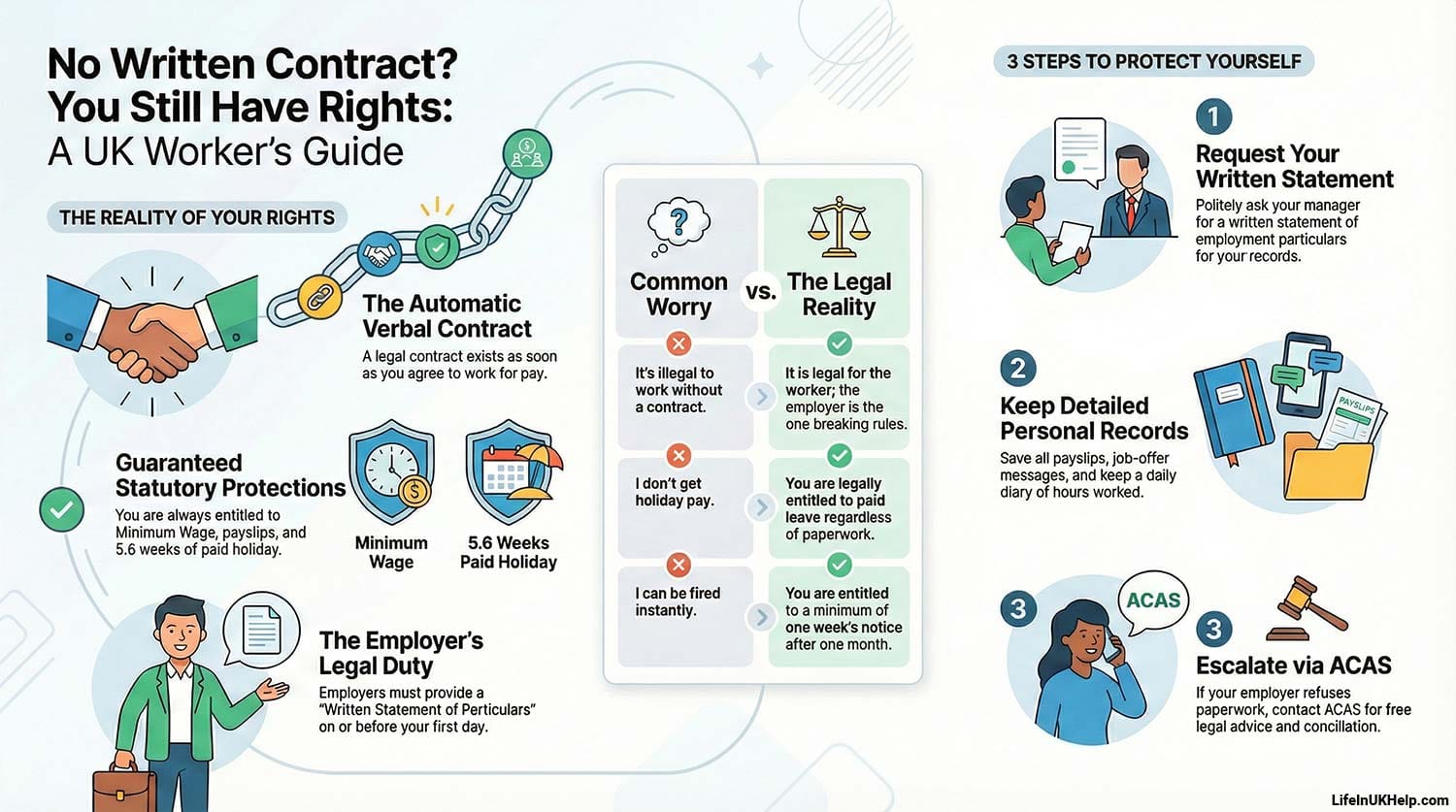
If you are working without a written contract, you still have rights. Here is the reality:
- It is not illegal for you. You are not breaking the law by working without a written contract, as long as you are paying tax.
- A contract exists automatically. As soon as you accept a job and start working for pay, a “contract” is created. This is called a verbal employment contract in the UK
- You have statutory rights. Even without paper, you are entitled to the National Minimum Wage, holiday pay and payslips.
- The employer is breaking the rules. By law, your employer must give you a document called a “Written Statement of Particulars” on your first day.
Did you know?
In the UK, you can still have work rights even if you don’t have a written contract. The law looks at how you really work, not just what is on paper. This means some rights can start from your first day.
Your Verbal Employment Agreement
In the UK, a “contract of employment” does not have to be a long document signed with a pen. It is an agreement between you and your employer.
What is a Verbal Contract?
If your boss offers you a job, tells you the pay, and you agree to do the work, you have made a contract. This is valid under UK law. Even if nothing is written down, the law still recognises you as an employee. This means that although there is no written employment contract, you still have full employment rights.
Is it Illegal?
- For the worker: No. You are not in trouble.
- For the employer: Yes, they are failing their legal duty. Since April 2020, employers must provide a “Written Statement” on or before your first day of work. This document lists your pay, hours, and holiday entitlement.
Your Automatic Rights:
- At least the National Minimum Wage.
- Paid holiday (5.6 weeks per year).
- Payslips (showing your tax and National Insurance).
- Protection against discrimination.
- Weekly or monthly rest breaks.
Step by Step Guide
If you are working in the UK without a written contract, follow these steps to fix the situation.
Step 1
Ask for your “Written Statement” Speak to your manager politely. Say: “I need a written statement of my employment particulars for my records. When can you provide this?”
Step 2
Keep your own records Because you don’t have a paper contract, you need proof of what was agreed.
- Save text messages or emails offering the job.
- Keep every payslip.
- Write down the hours you work in a diary every day.
Step 3
Send a formal letter If asking politely doesn’t work, send a formal email or letter. State that you are legally entitled to a Written Statement of Particulars under the Employment Rights Act 1996.
Step 4
Contact ACAS (Advisory, Conciliation and Arbitration Service) If they still refuse. They give free advice and can help you talk to your employer.
Simple Example
Sam started working in a pizza shop in London. The owner, Mr. Jones, shook his hand and said, “£12 an hour, Tuesday to Saturday.” He never gave Sam a paper contract.
After three months, Sam wanted to take a week off for holiday. Mr. Jones said, “You don’t get holiday pay because you don’t have a contract.”
This is wrong. Sam has a verbal employment contract in the UK. Because he is a worker, the law gives him holiday pay automatically. Sam showed Mr. Jones the government rules on his phone. Mr. Jones realised he was breaking the law and agreed to pay Sam for his holiday.
Important Things to Know
Here are some specific details you should be aware of:
- Zero-Hours Contracts: Even if you are on a “zero-hours” contract, you still have the right to a written statement.
- Probation Periods: You are entitled to a written contract even during your probation period.
- Notice Period: If you have worked for more than 1 month but less than 2 years, you must give (and receive) at least 1 week’s notice before leaving, even without a written contract.
- Cash in Hand: Working for cash is okay only if the employer gives you a payslip and deducts tax. If they pay cash with no payslip, you have no proof of employment, which is very risky.
Tips and Warnings
- Warning: Be careful of “Self-Employed” tricks. Some bosses say “you have no contract because you are self-employed” to avoid paying for your holidays. If they decide your hours and equipment, you are likely a worker, not self-employed.
- Tip: Never work for long periods without payslips. Without payslips, you cannot prove you paid tax, which can hurt your visa status or future state pension.
- Mistake: Do not be afraid to ask. Asking for a contract is not rude; it is your legal right.
Official Information Source
You can read the full rules about employment contracts and written statements on the official government website. Official guidance on GOV.UK about Employment Contracts.
FAQs
1. If I have no contract, can I leave without giving notice?
Many people think that having no written contract means they can quit instantly. This is incorrect. If you have worked for your employer for more than one month, the law (statutory notice) requires you to give at least one week’s notice before leaving. This is the legal minimum and your actual notice period might be longer if something different was agreed verbally or in writing. Similarly, your employer must give you at least one week’s notice if they want to dismiss you, unless there is a serious reason such as gross misconduct.
2. How do I prove I am an employee if there is a dispute?
If you need to prove your employment to a landlord, the council or a tribunal, you can use other evidence. The best forms of proof include:
A. Payslips (most important)
B. Bank statements showing salary deposits
C. Text messages or emails discussing work hours
D. Rotas or shift schedules
E. P45 or P60 forms
3. Am I entitled to Statutory Sick Pay (SSP) without a written contract?
Yes. Your right to SSP depends on your earnings and employee status not a written contract.
Current rules (until 5 April 2026): You qualify if you earn an average of £125 or more per week and are sick for 4+ days.
New rules from 6 April 2026: All employees qualify from day one of sickness, regardless of earnings. Check GOV.UK for the latest rates.
4. Is a text message offer legally binding?
Yes. In the UK, a job offer made via text message, WhatsApp or email can count as part of your employment contract. If the message says “Start Monday, £13/hour, 40 hours a week” and you reply “Yes” a legal agreement has been made. Keep screenshots of these messages safe.
Conclusion
Working in the UK without a contract can feel stressful, but you are more protected than you think. You have a verbal contract and statutory rights that your employer cannot ignore. However, having a written document is always better to avoid arguments later. If you haven’t received yours, ask your employer for it today. It is their legal duty to give it to you.
Related Articles on My Website
Have a question in mind?
Post it in the comments. I will reply and share the answer with everyone. For personal queries, please reach me via my Contact page.
Hi Mr Davis
Can my employer fire me instantly if I don’t have a contract?
Thank you
Hello my friend
No. Even without written documents, you still have legal rights. In most normal situations, your employer cannot just dismiss you immediately. They should either allow you to work during your notice period or pay you for that time instead. The only exception is if you have committed something very serious, known as Gross Misconduct, such as theft or violent behaviour.
Good luck