

Introduction
Making a mistake on your Universal Credit claim can feel frightening. Many people realise after submitting a form that they entered the wrong date, income figure, or rent amount.
If you’ve discovered a Universal Credit mistake in your application or change of circumstances, don’t panic. Most errors can be corrected if you act quickly and explain clearly.
This guide explains what usually happens next, whether you could be fined, and how to fix the problem step by step.
New to the UK? Check out our Living in the UK Guide to see the full picture.
What Happens After a Universal Credit Change of Circumstances Mistake?
When you report a change, such as starting work, moving home or changes in savings the system recalculates your payment for that assessment period.
If the information was incorrect:
- Payments may adjust from the start of your assessment period
- The DWP may send a message asking for clarification
- You may need to provide evidence
In most cases, it is treated as a normal error, not fraud, especially if you report it yourself. The key factor is how quickly you correct it.
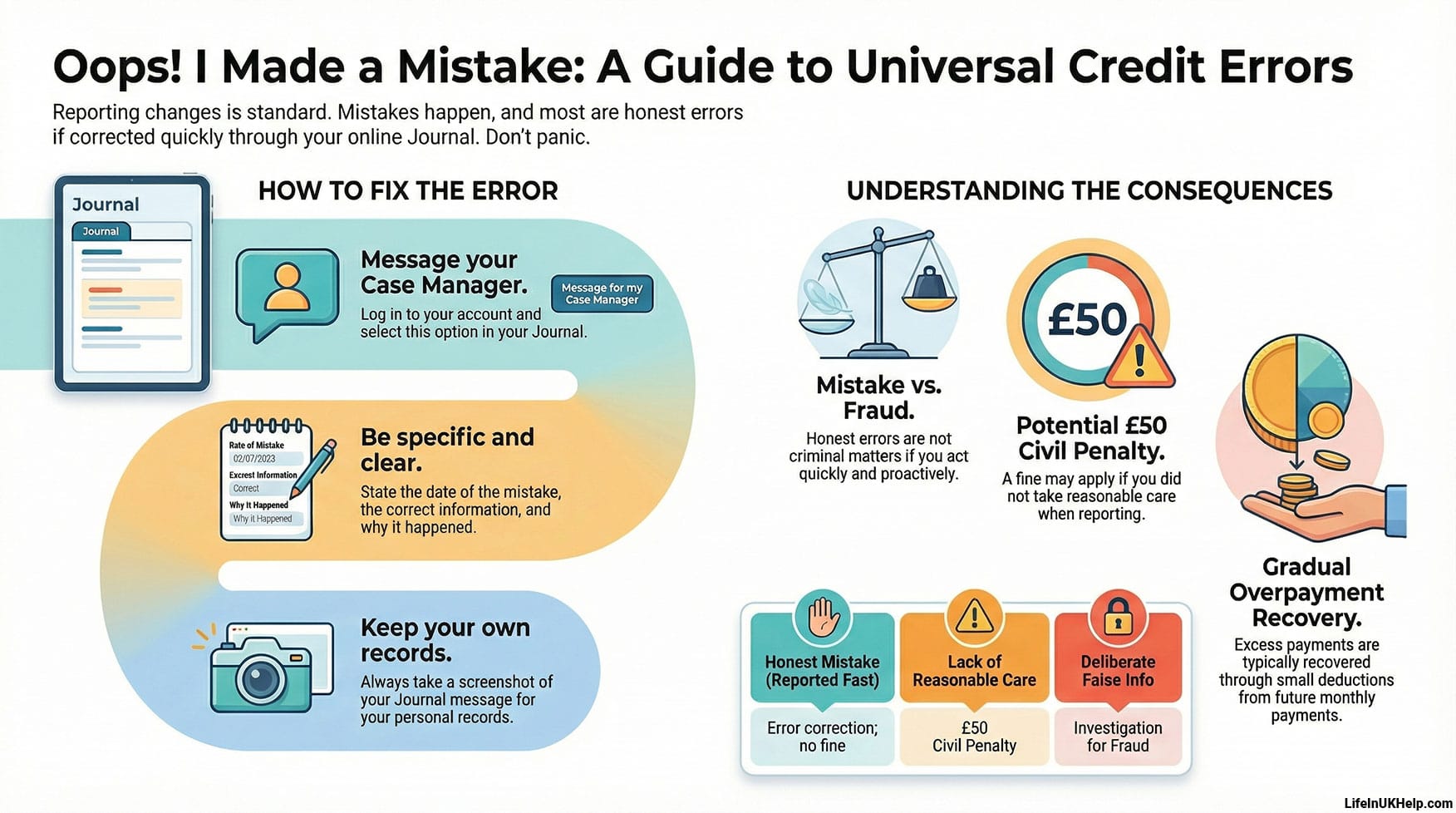
Honest Mistake vs Fraud
It is important to understand the difference.
An honest mistake means:
- You typed the wrong date
- You misunderstood a question
- You forgot to include information
Fraud means:
- You knowingly provided false details
- You intended to receive more money
If you correct your error quickly through your Journal, it is normally handled as a claimant error rather than a criminal matter.
Did you know?
The DWP regularly checks your information with HMRC and other agencies. If you notice a mistake in your income or savings, do not wait for them to find it. Telling them about the error quickly can help you avoid serious investigations and penalties.
Universal Credit Overpayment: What Happens Next?
If your mistake caused you to receive too much money, this is called an overpayment.
Many people search for “Universal Credit overpayment what happens” because they fear getting punished.
What typically happens:
- DWP calculates overpayment amount
- Most claimant errors = recoverable
- Deducted gradually, max 15% (was 25%) of standard allowance
You won’t repay everything at once. DWP considers your finances. Hardship? Request lower deductions.
The £50 Civil Penalty for Universal Credit Errors
Some claimants worry about the £50 civil penalty universal credit rule.
The DWP can apply a £50 Civil Penalty if they believe you did not take reasonable care when reporting information.
Important points:
- It is not a criminal conviction
- It is added to your Universal Credit debt
- It does not automatically affect your credit score
Quick reporting reduces penalty risk, but it’s not guaranteed, DWP decides case-by-case.
The penalty is more likely if:
- You ignored requests for clarification
- You repeatedly gave incorrect information
- You failed to check basic details
Could My Payment Be Stopped?
Sometimes, payments may pause temporarily while the DWP verifies information.
This is more common if:
- Housing costs are involved
- Income details are unclear
- Evidence has not been provided
If your payment is due soon and you have not received a response in your Journal, contacting the helpline may help.
How to Correct a Universal Credit Journal Mistake
If you are searching for how to correct universal credit journal mistake, the answer is simple: act fast and be clear.
Follow these steps:
Step 1
Log in to your Universal Credit online account.
Step 2
Go to your Journal.
Step 3
Select “Message for my Case Manager.”
Step 4
Write clearly:
“I made a mistake on a change of circumstances reported on (date).”
Step 5
Explain:
- What was incorrect
- The correct information
- Why the mistake happened
Step 6
Keep a screenshot for your records.
Clear communication helps resolve issues faster.
Example
Sam reported that he moved home on 1 April. The correct date was 10 April. Because of the earlier date, he received slightly more housing support.
Three days later, he noticed the mistake and wrote in his Journal.
The DWP corrected the record and recovered the small overpayment over two months. He was not fined because he reported it quickly.
Important Things to Remember
- Report errors within a few days if possible
- Always check the “effective date” / the date the change actually happened
- Keep copies of your communication
- Do not ignore errors
The DWP cross-checks information with HMRC and other systems. Fixing the mistake yourself protects you.
What If I Disagree With a Decision?
If you believe the overpayment amount is wrong or you receive a penalty you disagree with, you can request a Mandatory Reconsideration.
You usually have one month from the decision date to request this review.
During reconsideration, the DWP reviews the evidence again.
Does This Affect My Future Claims?
An honest mistake corrected quickly does not normally affect future claims.
However, confirmed benefit fraud can lead to:
- Larger penalties
- Possible prosecution
- Immigration consequences in serious cases
This is why early correction matters.
Conclusion
Making a Universal Credit mistake is stressful but it is rarely a legal disaster if you handle it properly.
Remember:
- Act quickly
- Use your Journal
- Be honest
- Keep records
- Most mistakes can be corrected without serious consequences.
Frequently Asked Questions
1. How long does it take the DWP to correct a mistake?
It usually depends on your assessment period. Some corrections happen within days, others appear in the next monthly statement.
2. Can I update a change after the assessment period ends?
You cannot edit directly, but explain in Journal ASAP. Note: prior overpayments may still be recovered by DWP.
3. Will an overpayment reduce my future payments significantly?
Deductions are usually capped at a percentage of your standard allowance. The DWP does not normally leave you without basic support.
4. Can multiple small mistakes lead to an investigation?
Repeated errors may raise questions. Clear explanations and evidence reduce this risk.
5. Should I call instead of using the Journal?
The Journal is the official written record and is usually best. Calling can help if your payment is urgent.
Questions about this topic?
Leave a comment below and I will respond so others can learn too. Need private support? Head over to my Contact page.
Hi,
Does a £50 Civil Penalty appear on a criminal record?
Hi Mate
No worries. It is an administrative penalty, not a criminal conviction.