


Introduction
Moving to the United Kingdom is an exciting start to a new life. But many people from other countries do not realise that some everyday habits or common items can cause serious legal problems here. The UK has laws that may be very different from your home country.
This article is for new residents, students and workers especially people coming from outside Europe. We will explain the most important UK laws newcomers should know in very simple English. Understanding these rules will help you protect your visa, your job, and your future in Britain.
Table of Contents
Why People Search for This Topic
Many newcomers worry about making a mistake they did not know was wrong. A legal problem (even a small one) can have very serious consequences in the UK. It can stop you from renewing your visa, finding a job or renting a home. People want to understand the system so they can live peacefully and safely.
Quick Summary / The Most Important Rules
- Never carry a knife or weapon in public even for protection.
- Always check your visa conditions before you start working.
- You need a valid licence, insurance and MOT to drive legally.
- Private e-scooters are illegal on public roads.
- Pay your Council Tax, it is not optional.
- A police caution stays on your record and can affect your visa.
- Respect privacy, do not photograph strangers or children.
- Wait in queues, it is a serious part of British culture.
- Hate speech and discrimination are serious crimes.
- Being drunk in public and making noise at night can lead to fines.
A Closer Look
Here is a deeper look at each area where newcomers sometimes face problems.
1. Knife Laws and Weapons
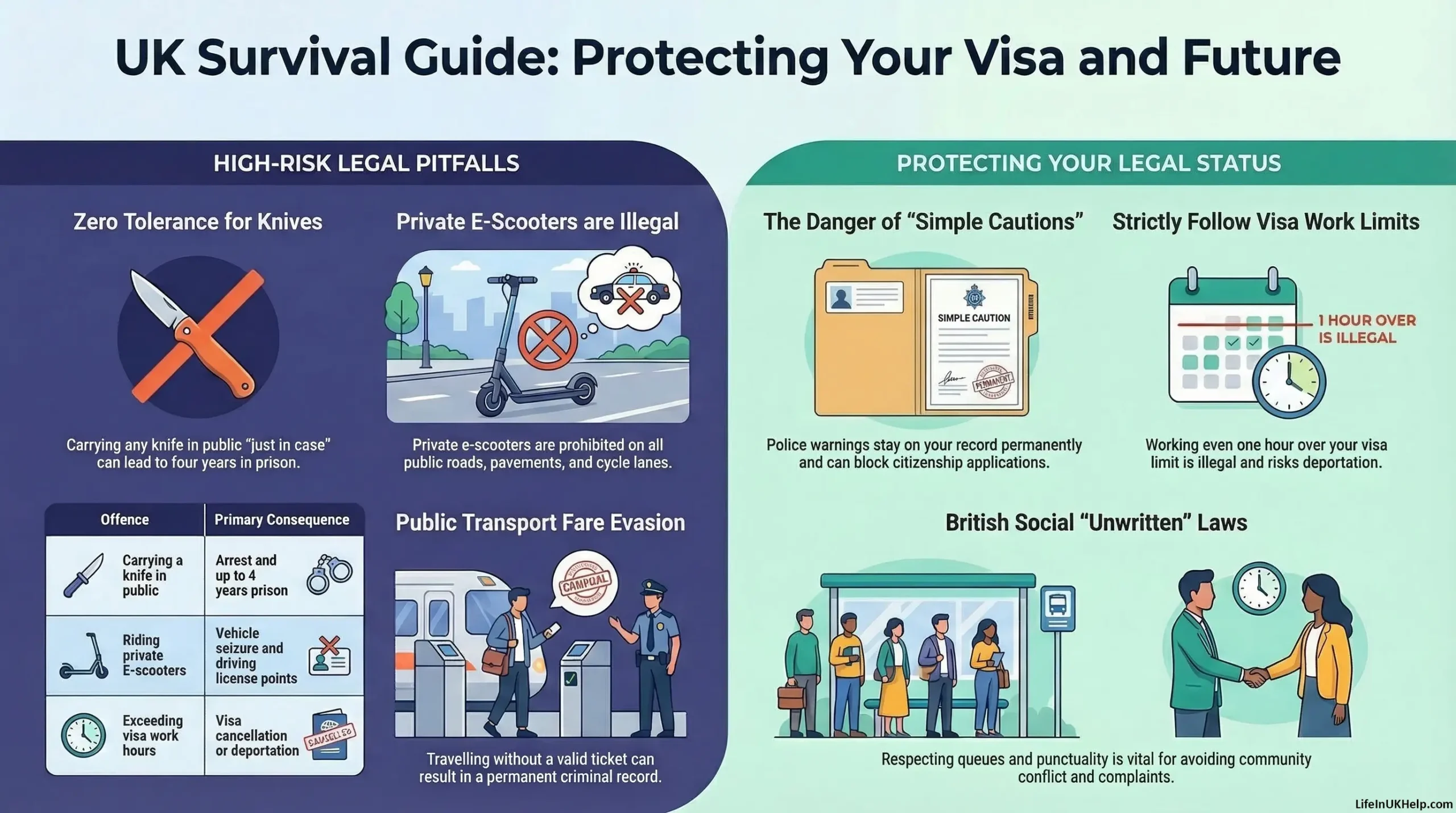
In many countries, carrying a small knife is normal. In the UK, it is a serious crime. You cannot carry a knife in public “just in case” or for self-defence. Even a small knife in your pocket, with no bad intention can lead to arrest and up to four years in prison.
There are a few very limited exceptions, for example, for work (such as a chef travelling to their job) for religious reasons or as part of traditional dress. However, these exceptions are narrow and checked very carefully by the police. For normal everyday life, there is almost never a good legal reason to carry a knife in public. The safest choice is simple: DO NOT carry any knife outside your home.
2. Visa and Work Rules
You must always follow the rules of your visa. For example, students on a student visa can only work a limited number of hours per week. Working more than allowed is illegal and can lead to visa cancellation or deportation. Always check your visa conditions on GOV.UK
3. Driving Laws
You can usually use a foreign driving licence in the UK for up to 12 months. After that, you must get a UK licence. You must also always have valid car insurance and an up to date MOT and car tax. The police use cameras to check insurance automatically. Driving without these documents can lead to heavy fines or losing your licence.
4. Electric Scooters (E-scooters)
E-scooter rules in the UK are very strict. Private e-scooters are not allowed on public roads, pavements, or cycle lanes even if they look exactly like the ones you see other people riding.
The only e-scooters you can legally ride in public are those in official government rental trials. These are clearly marked as rental scooters and follow special rules. If you are caught riding your own private e-scooter in public, the police can seize it and add points to your driving licence.
5. Tax and National Insurance
If you work in the UK, you must pay income tax and National Insurance contributions. If you are employed, your employer usually handles this automatically. If you are self-employed, you must register with HMRC yourself. Working cash-in-hand without reporting it can create serious legal and visa problems.
6. Renting and Housing Rules
When you rent a property, you must have a proper tenancy agreement. Landlords in England are required by law to check your immigration status (this is called the “Right to Rent” check). Subletting a property without permission or overcrowding a home can break housing regulations and cause legal problems.
7. Privacy and Children
British people value their privacy greatly. Taking photos of people in public places is usually legal, but photographing strangers or children may make people uncomfortable and could lead to complaints. Because of this, it is considered very rude and sometimes suspicious to take photos of strangers, especially children. If you are in a park or public place, it is best to ask permission before photographing someone else’s children or family. It is also polite to avoid asking strangers very personal questions, such as how much money they earn.
8. Alcohol and Public Behaviour
You must be 18 years old to buy alcohol in the UK. Being drunk and disorderly in public is a crime. Some areas have (Public Spaces Protection Orders) (PSPOs) that make it illegal to drink alcohol on certain streets. Always look for signs. Loud noise at night can also lead to fines from the local council.
9. Public Transport Rules
You must always buy a valid ticket before you travel, or (tap in) with a contactless card. Ticket inspectors check frequently and saying (I didn’t know) is not an accepted excuse. Never put your feet on seats. this is considered anti-social behaviour. Always offer your seat to elderly or disabled passengers.
10. Hate Speech and Discrimination
UK law strongly protects people from hate crime and discrimination. Using insults based on someone’s race, religion, gender, sexuality or disability is a serious crime called a (Hate Crime). Treating people unfairly for these reasons at work or in public is also illegal. The UK is a multicultural country and everyone is protected equally by law.
Important / Criminal Records and Your Visa
Even a Simple Caution (a formal police warning not a court case) stays permanently on your record. This can show up on background checks for jobs in healthcare, education or finance. More importantly, the Home Office checks criminal records when you apply to extend your visa or apply for British Citizenship. Any conviction (however small) can have a very serious impact on your right to stay in the UK.
What to Do if the Police Stop You
Many newcomers feel nervous if the police stop them. This is normal. Knowing what to do will help you stay calm and protect your rights.
- Stay Calm: Stop, keep your hands visible and do not shout or run away.
- Ask Why: You can politely ask: (Why have you stopped me?) The officer must give you a reason.
- If They Want to Search You: This is called (Stop and Search.) The officer must tell you their name, their police station and the legal reason for the search. You can ask for a written record of the search.
- Providing Your Details: You do not always have to give your name and address, but there are important exceptions. If you are driving or if the police believe you have committed an offence, you usually must give your correct details. In these situations, refusing to give your name and address can itself become a separate criminal offence. If you are unsure, it is usually safest to stay calm and cooperate.
- If You Are Arrested: You have the right to a free lawyer (called a solicitor). Always ask for one before answering any detailed questions at the police station.
Warning
Never offer money to a police officer. This is called (bribery) and is a serious crime in the UK. You will be arrested immediately.
A Simple Real-Life Example
Sam is walking to his new job. He has a small pocket knife in his bag because he uses it to peel fruit at lunchtime. A police officer stops him for a routine check and finds the knife. Even though Sam had no bad intentions, he can be arrested because carrying a knife in public without a legal reason is a crime. This arrest could create a criminal record that stops him from renewing his visa in the future. The solution is simple: leave the knife at home and use a knife at work or in the canteen instead.
Important Social Rules (Unwritten Laws)
In the UK, some (rules) are not written in law, but breaking them can cause serious problems with neighbours, coworkers or the community. Here are the most important ones.
Queueing (Waiting in Line)
British people take queuing very seriously. Whether you are at a bus stop, a shop or a coffee bar, you must always join the back of the line and wait your turn. Pushing in front of others is seen as one of the rudest things you can do. It can cause arguments and complaints.
Being on Time
Punctuality is very important in British culture. If you have an appointment, a job interview or a meeting at 10:00, you should arrive at 09:55. Being 10 minutes late is considered rude and may result in your appointment being cancelled.
Noise and Being a Good Neighbour
Noise is one of the biggest causes of complaints in the UK. Loud music, parties late at night or shouting can lead to a formal complaint to the council. If the problem continues, the council can take legal action. This is called an -Anti-Social Behaviour- (ASB) complaint.
These social rules are not criminal offences, but following them helps you avoid conflict and build better relationships with neighbours and colleagues.
Tips and Warnings to Remember
✅ Tip: Keep copies of all important documents, your tenancy agreement, visa documents, payslips and official letters. If you are unsure whether something is legal, check the GOV.UK website or visit a local Citizens Advice centre, it is free.
✅ Tip: Keep your visa expiry date saved in your phone calendar with a reminder 3 months before the date. This gives you enough time to apply for an extension.
⚠️ Warning: Never sign a legal document you do not understand. Ask a trusted person, a solicitor or Citizens Advice to explain it to you first.
⚠️ Warning: Council Tax is not optional. If you do not pay, the council can take you to court. Check with your landlord whether Council Tax is included in your rent or whether you need to pay it separately.
Official Information Source
For full and accurate details about UK law, visit the official government website: GOV.UK – Crime, Justice and the Law
Conclusion
Building a new life in the UK is a great opportunity. But it requires more than finding a job or a place to live. Respecting the local laws and social rules is the best way to protect your future here.
By following these 10 basic UK laws newcomers should know and understanding the important social rules, you will avoid common mistakes, protect your visa and show that you are a valued member of your community.
If you are ever unsure about a rule or a situation, do not guess. Check GOV.UK, visit a Citizens Advice office or ask a legal advicer. It is always better to ask first than to make a mistake.
Frequently Asked Questions (FAQ)
1. Can I carry a small knife if I am using it for my work as a chef?
Yes, but you must only carry it while travelling directly to or from work. It should be kept safely in a tool bag, not in your pocket. If the police stop you, you must be able to prove you are a chef and that you are on your way to a shift.
2. Is it true that I can get a criminal record for not buying a train ticket?
Yes. Travelling on public transport without a valid ticket is (fare evasion.) While many people just get a fine (Penalty Fare), the transport company can take you to court. A court conviction for fare evasion will appear on your criminal record.
3. What should I do if my neighbours are making too much noise?
First, try to speak to them politely if you feel safe doing so. If the noise continues, do not call the police unless there is a crime. Instead, contact your local council’s Environmental Health department to make a noise complaint.
4. I have a driving licence from my home country. Can I drive a private e-scooter?
No. Even if you have a full driving licence, private e-scooters are illegal on UK public roads. Having a licence does not make it legal to ride a vehicle that is not allowed on the road.
5. Will a “Simple Caution” from the police affect my application for British Citizenship?
Yes. When you apply for citizenship, the Home Office looks at your “good character.” A caution stays on your record and can lead to your application being refused, especially if it happened recently.
Related Articles on Life in UK Help
- The Complete Guide to UK TV Licence Rules
- How to Register with a GP as a Newcomer
- Late Council Tax Registration Penalty
Questions about this topic?
Leave a comment below and I will respond so others can learn too. Need private support? Head over to my Contact page.