

Living in the UK for Beginners: A Clear Roadmap
Moving to a new country is exciting, but it can also feel confusing. Everything works differently from how you see a doctor to how you pay your rent.The UK has very organised systems, but they are not always easy to understand at first.
If you are new here, you might be asking: “What should I do first?” or “How do I avoid mistakes?”
This living in the UK guide for beginners is written specifically for people who have just arrived or are planning to move. It uses simple English and focuses on real life, avoiding complex legal language.
In this guide, you will learn how the main UK systems connect together. We will cover money, housing, health, and work. Think of this page as your “roadmap” to settling in.
Overview: How Life in the UK Works
Living in the UK means dealing with several different systems at the same time. Many newcomers struggle not because the rules are difficult, but because they do not know the correct order to do things.
For example, to rent a house, you often need a bank account. But to open a bank account, you often need an address. This vicious circle is common.
This guide gives you a clear overview of the main pillars of life in the UK:
- Money: How to pay for things and open a bank account.
- Housing: Understanding rent, deposits, and Council Tax.
- Health: How to use the NHS for free.
- Work: Paying tax and understanding your rights.
- Transport: Getting around cities and the country.
You usually need this information in your first few weeks. Let’s start with the most important system: Money.
1. Money and Banking in the UK
The UK is quickly becoming a cashless society. In many coffee shops, buses, and stores, you cannot pay with cash at all. You need a bank card or a phone with Apple Pay/Google Pay.
Opening Your First Bank Account
Opening a bank account is often the first big challenge for immigrants. Traditional “High Street” banks (like Lloyds, Barclays or HSBC) often ask for “proof of address” (like a utility bill) which you might not have yet.
The Solution: Many newcomers start with digital banks (like Monzo, Revolut or Starling). These are fully regulated UK banks but are easier to open using just your passport and a photo from your phone.
Building a Credit Score
In the UK, your “Credit Score” is very important. It is a digital record that shows if you are good with money. You need a good score to get a phone contract, rent a nice flat or get a credit card later.
Related Guides for More Detail:
2. Housing, Renting and Bills
Finding a place to live is the next step. Most people rent privately when they first arrive. Renting involves signing a contract called a “Tenancy Agreement.”
Understanding the Costs
When you see a rental price (e.g. £1,000 per month), that is usually just the rent. You must also pay extra for:
- Utilities: Gas, electricity, and water.
- Internet: Broadband connection.
- Council Tax: This is a special tax paid to the local government for services like rubbish collection and street lights. It can be £100-£200 per month.
Deposits and Protection
Landlords will ask for a “Security Deposit” (usually 5 weeks rent). By law, they must put this money into a government-protected scheme (TDP). They cannot just keep it in their personal bank account. If they do, they are breaking the law.
Related Guides for More Detail:
3. Healthcare and the NHS
The National Health Service (NHS) is one of the most important systems in the UK. For most residents, healthcare is free at the point of use. You do not pay to see a doctor or go to the hospital.
The Role of the GP (General Practitioner)
In the UK, you cannot usually go directly to a specialist (like a dermatologist or cardiologist). You must first register with a local doctor called a GP.
The GP is your “gatekeeper.” If you are sick, you go to them first. If they cannot fix the problem, they will refer you to a hospital specialist. Registering with a GP should be one of your top priorities.
Emergencies vs Non Emergencies
- 999: For life threatening emergencies only.
- 111: For urgent medical advice when it is not life threatening.
- Pharmacy: For minor issues like colds or headaches.
Related Guides for More Detail:
4. Working and Paying Tax
Before starting work or settling long-term, it’s important to understand UK laws that may be very different from your home country. One key legal area to understand is how tax and employment work in the UK. If you are working in the UK, your employer will usually deduct tax from your salary before they pay you. This system is called PAYE (Pay As You Earn). This means you do not need to file a tax return yourself unless you are self-employed.
National Insurance Number (NINO)
To work legally, you need a National Insurance number. This number tracks your tax and pension contributions. You can start working without one, but you must apply for it as soon as possible.
Know Your Rights
Even if you do not have a written contract, you have rights. You are entitled to the National Minimum Wage, paid holidays, and rest breaks. Never accept work that pays “cash in hand” below the minimum wage. It is illegal and leaves you unprotected.
Related Guides for More Detail:
- Understand your UK payslip and tax codes
- 3 Free Websites to Get UK Certificates Online
- How to Get a Job in the UK Without UK Experience?
- How to Get a National Insurance Number in the UK?
- 10 Essential UK Laws Newcomers Don’t Know About
- Working in the UK without a contract: what are your rights?
- Can Volunteering Break My UK Visa? What Students & Skilled Workers Must Know
- Can My Employer Cancel My Shift on a Zero-Hours Contract?
5. Getting Around: Transport Systems
Public transport in the UK is generally good, but it can be expensive if you don’t know the tricks.
- London: London uses a specific system (Oyster Card or Contactless bank card). You tap in and tap out. Buses in London do not accept cash.
- Trains: Trains between cities are very expensive if you buy tickets on the day of travel. Always book in advance to save money.
- Buses: Outside London, buses are the main way to get around locally. Many areas now have a £2 cap on single bus fares.
Related Guides for More Detail:
Your Settling In Roadmap: The First 30 Days
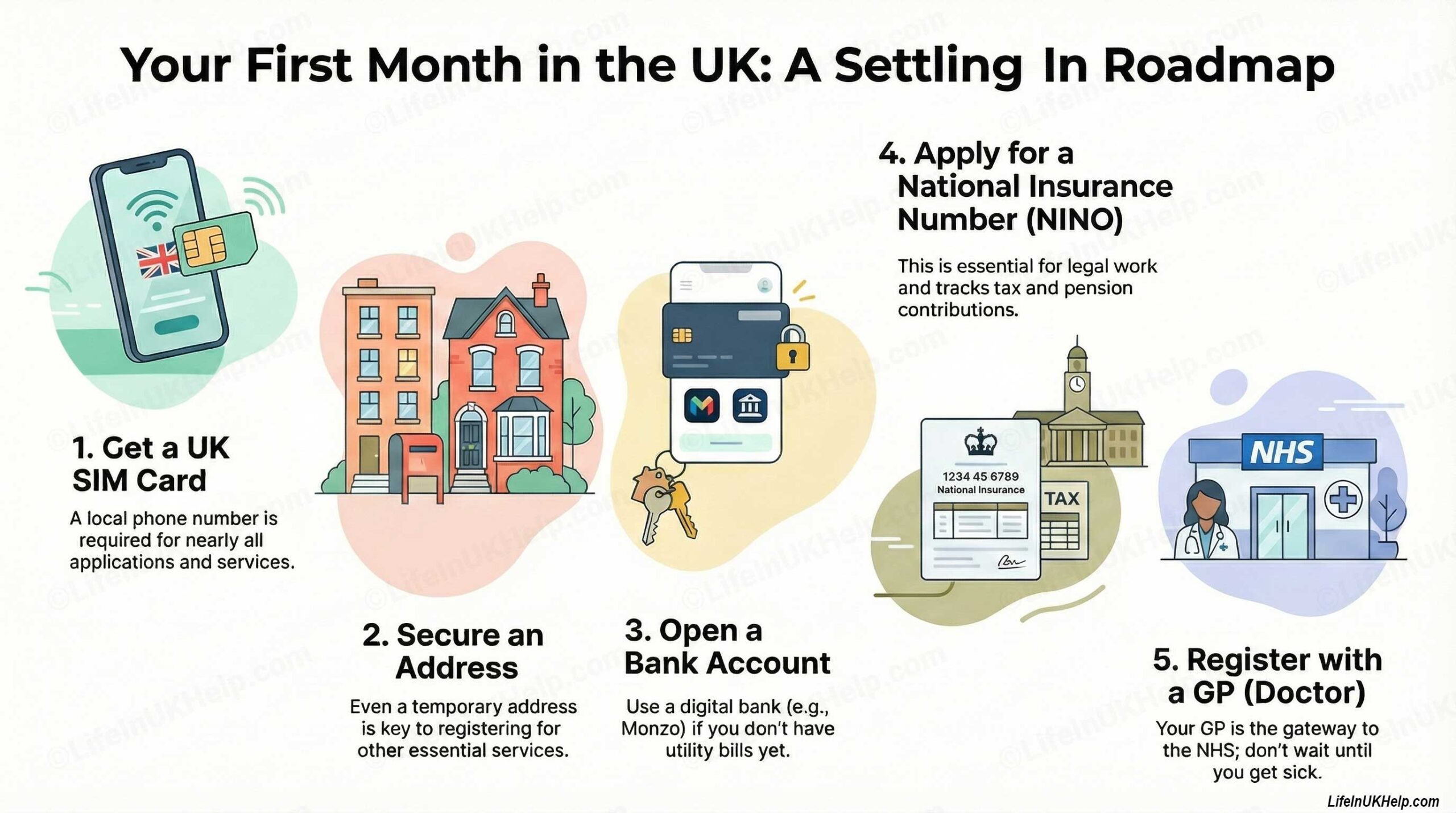
Checklist: Your First Month in the UK
If you feel overwhelmed, just focus on these 5 steps in your first month.
- Get a SIM Card: Best SIM Card for New Immigrants in the UK
- Find an Address: Even a temporary address allows you to register for services.
- Open a Bank Account: Use a digital bank if you don’t have utility bills yet.
- Apply for a National Insurance Number: Do this as soon as you are looking for work.
- Register with a GP: Don’t wait until you get sick.
Frequently Asked Questions
1. Do I need to do everything in my first week?
No. Focus on getting a phone number and a bank account first. The rest can happen in the first month.
2. Can I work before getting a National Insurance number?
Yes, you can start working if you can prove you have the right to work in the UK (like a visa or BRP, see Here). You just need to tell your employer you have applied for the number.
3. Is healthcare really free in the UK?
Yes, seeing a doctor and hospital treatment is free for residents. However, in England, you usually have to pay a small fee for prescriptions (medicine) unless you are exempt.
4. Why do I have to pay Council Tax?
Council tax pays for local police, rubbish collection, parks, and libraries. It is a mandatory tax for almost every household.
Conclusion
Living in the UK becomes much easier once you understand how the systems connect. Most problems happen because people get information in the wrong order or assume things work the same way as in their home country.
This guide gave you a clear overview of life in the UK. Now, take things step by step. If you are not sure where to begin, start with The Bank Account Guide. Use the links in each section above to read the detailed guides when you are ready to take action.
Welcome to your new home!
Not sure about something?
I am here to help. If you have specific questions, feel free to reach out directly via my Contact page.