

| 💡 Who is this article for? Many immigrants arrive in the UK with this question on their mind: can I go to university here, and where do I even begin? The answer is yes, but it depends on a few things: how long you have been in the UK, your immigration status, and what qualifications you already have. This guide walks you through all of it in plain English. Rules can change depending on UK immigration and education policy updates, so always check official sources for the latest information. |
Table of Contents
Note: Most of the information here applies to England. Scotland, Wales and Northern Ireland have their own rules for fees and student finance, so if you are based outside England, check your region separately.
Why People Search for This Topic
Moving to a new country is hard enough. Working out how to study at university in the UK as an immigrant and what that even involves can feel overwhelming on top of everything else. A lot of people who come here have studied before, sometimes to a high level and they want to know whether any of that counts or whether they have to start again from scratch.
There are also real concerns about money. One of the most common questions is about student finance eligibility for immigrants in the UK, whether you can access it at all or whether you will be charged much higher fees as an overseas student. These are completely understandable worries and this article tries to answer them honestly.
Short Answer
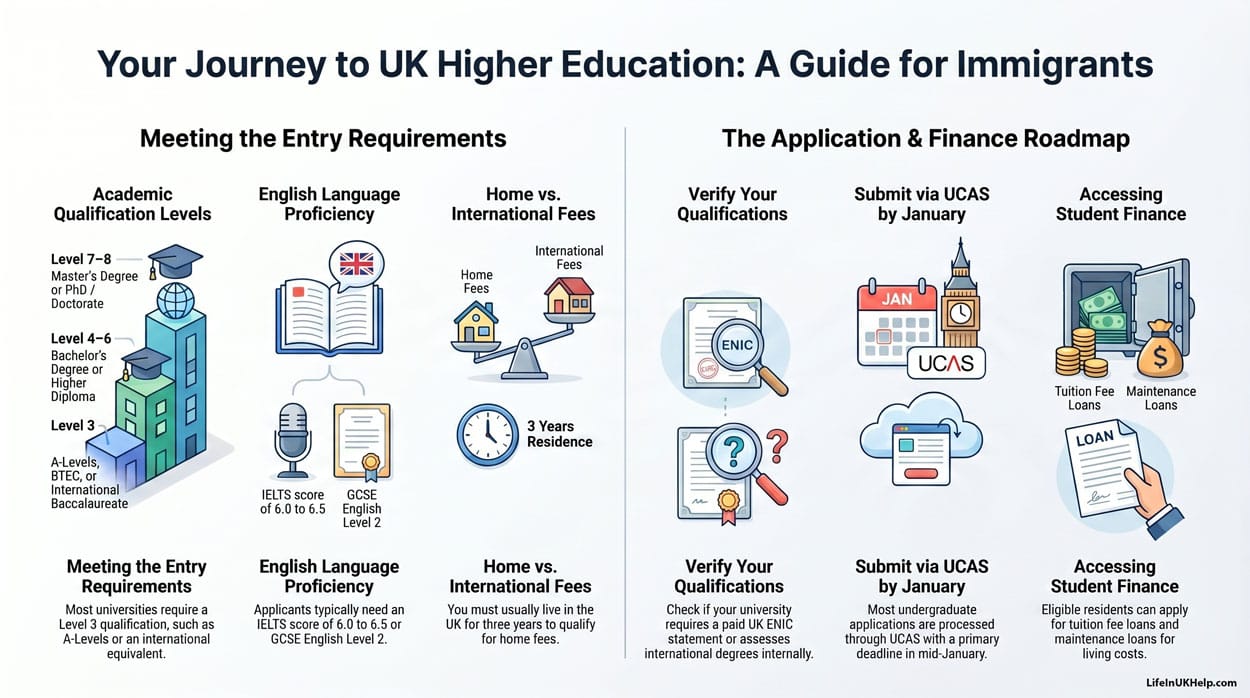
| Here is what you need to know: 1. Yes, you can go to university in the UK as an immigrant. 2. You usually need a Level 3 qualification (or equivalent) for direct entry. 3. You must meet English language requirements (usually IELTS 6.0–6.5 or equivalent accepted English tests) 4. You may qualify for home fees and student finance after 3 years in the UK if you also meet eligible immigration status requirements. 5. Most applications are made through UCAS 6. Many universities also accept international qualifications and offer foundation or access courses if needed. |
Full Explanation
In the UK, “university” and “higher education” mean the same thing. It refers to any study at Level 4 or above, which covers bachelor’s degrees, master’s degrees, PhDs and certain professional qualifications. For example, a PGCE is required if you want to train as a teacher.
The UK education system works in levels. Everyone is expected to reach Level 2 (GCSE) by the age of 16 and Level 3 (such as A Levels or a BTEC) by 18. After that, the choice is yours, work, university, an apprenticeship or further training. University is generally for people aged 18 and over, though many mature students return to education much later in life.
| UK Level | Qualification |
|---|---|
| Level 2 | GCSE or equivalent |
| Level 3 | A Levels, BTEC, T-Levels, International Baccalaureate |
| Level 4-6 | Degree, Higher Apprenticeship, Higher Diploma |
| Level 7 | Master’s Degree |
| Level 8 | PhD / Doctorate |
As for what you can actually study, pretty much anything. Sciences, engineering, business, health and social care, education, arts, technology, law. A standard bachelor’s degree takes three years full-time. A master’s is typically one to two years and a PhD usually takes three to five years depending on the subject.
If you have been out of education for more than five years or you do not yet have a Level 3 qualification, do not assume university is off the table. Many universities offer an Access to Higher Education Diploma or a Foundation Year specifically designed for people in this situation including immigrants whose international qualifications are not directly recognised in the UK. These are well-established routes and universities take them seriously.
Step by Step Guide to Applying
- STEP 1: Start by finding out how your existing qualifications compare to UK standards. this is one of the first things immigrants need to sort out when thinking about university in the UK. The official body for recognising international qualifications is UK ENIC (enic.org.uk). They can issue a statement of comparability, but wait until your chosen university actually asks for one before paying for it. a lot of universities will look at your qualifications themselves and decide without needing a formal statement.
- STEP 2: Every university sets its own English language requirements, so it is worth checking early. Most ask for GCSE English at Level 2 or an IELTS score somewhere between 6.0 and 6.5 depending on the course. If your English is still developing, an ESOL course is a good place to build from. just be aware that ESOL on its own is not usually accepted as evidence of university-level English.
- STEP 3: Look into the specific course you want to study, not just the university. Entry requirements vary a lot between subjects. Some courses also require membership of a professional body, for example, nursing requires registration with the NMC. The university admissions team is the best place to ask. They deal with these questions all the time and are usually happy to help.
- STEP 4: Before you apply, check whether you qualify for student finance. Student finance eligibility for immigrants in the UK depends mainly on two things: your immigration status and how long you have been here. If you have lived here for at least three years and hold settled status, pre-settled status, refugee status or indefinite leave to remain, you may qualify for home fees and a student loan. The GOV.UK student finance pages explain the eligibility rules in detail.
- STEP 5: Most undergraduate applications go through UCAS (ucas.com). The main deadline is in January, but do not leave it too late, popular courses fill up quickly. If you have missed the main deadline, it is still worth contacting universities directly. Some courses have January intakes or will consider late applications, especially if places remain.
Example
| 👤 Fatima’s story: Fatima came to the UK from Afghanistan three years ago. Back home, she had completed a teaching degree. When she contacts the University of Chester admissions team, she is not sure whether any of that counts here. They tell her she does not necessarily need a formal UK ENIC statement, the university can assess her qualifications directly. They suggest she applies for a Foundation Year in Education. She checks the student finance eligibility rules, finds she qualifies for a tuition fee loan, puts in her UCAS application and starts her course that September. |
Important Things to Know: Fees and Finance
| Topic | Details |
| Tuition Fee Loan | Typically up to around £9,250 per year for home students (subject to future government changes). |
| Maintenance Loan | Means-tested loan to help with living costs |
| Repayment | Only when your income reaches a set level (via HMRC) |
| International Fees | Higher, vary by university and course |
| Islamic Finance Option | A proposed student finance option based on Islamic finance principles, not yet fully implemented at the time this article was written. |
| Degree Apprenticeship | Employer pays fees; you earn a salary, no repayment needed |
| Universal Credit | Most full-time students are not eligible, but there are exceptions such as students with children or those with disabilities. |
| 🕑 When is student finance paid? Student Finance arrives three times a year, in September, January and April. There is nothing in the summer, which catches a lot of people off guard in their first year. Budget ahead for this gap. |
Tips and Warnings
| 1. Hold off on paying for a UK ENIC statement of comparability until you actually need one. A lot of universities will look at your international qualifications themselves. Ask admissions before spending any money on it. 2. It is worth saying: not every career in the UK requires a degree. Some professions ask for membership of a specific body instead, nursing requires NMC registration, and solicitors need to go through the Law Society. If you are not sure what your chosen career actually needs, check before committing to three years of study. 3. Some courses, medicine, dentistry and a few others are extremely competitive and fill up early. If you have your heart set on one of these, apply through UCAS as early as you can, ideally in the autumn before the January deadline. 4. If taking an interest-based loan is not something you are able to do for religious reasons, the UK government has been working on an alternative student finance system based on Islamic finance principles. It has not been fully introduced yet, so keep an eye on GOV.UK for the latest updates on when it will be available. 5. ESOL courses are genuinely useful if you are working on your English but universities do not accept ESOL as proof of English ability. You will still need to reach GCSE Level 2 or get an IELTS score before you apply. |
Official Information Sources
(FAQ)
1. Can I go to university in the UK if I studied in another country?
Yes, you can. Most universities will look at your international qualifications. You might need a “statement of comparability” from UK ENIC, but ask the university admissions team first, as they often assess your certificates for free.
2. Do I have to pay “international fees” as an immigrant?
It depends on your status. Usually, if you have lived in the UK for three years and have settled or refugee status, you might qualify for “home fees,” which are much cheaper than international rates.
3. Can I get a student loan to help with costs?
If you meet the residency and immigration rules, you can apply for student finance. This helps with tuition fees and living costs. You only start paying it back when you earn over a certain amount.
4. What if my English is not good enough yet?
Most courses require an IELTS score of 6.0 to 6.5. While ESOL classes are great for learning, universities usually need a formal certificate like IELTS or a GCSE English Level 2 to accept you.
5. What can I do if my previous qualifications aren’t recognised?
Don’t worry, you don’t always have to start from scratch. Many universities offer “Access to Higher Education” diplomas or “Foundation Years” to help you get ready for a full degree.
6. Is there a specific age limit for starting university?
Not at all. While you must be at least 18, many people start university much later in life as “mature students.” UK universities value experience and welcome students of all ages.
Conclusion
| If you are asking can immigrants study in the UK, the answer is yes and we say that not just as a fact, but as something we genuinely want you to hear. A lot of people who come to this page are carrying real uncertainty. They have qualifications, they have ambition, and they are not sure whether any of it transfers. It does. Maybe not perfectly, maybe not without a few extra steps but there is almost always a way through. Start with the two things that matter most: your qualifications and your immigration status. Once you know where you stand on those, the rest becomes much clearer. And if you hit a wall, pick up the phone or send an email to the university admissions team. They have spoken to people in your exact situation before. You are not the first and asking is never a waste of time. |
Related Articles
- Do I need IELTS for UK university as an immigrant
- How to Get a Job in the UK Without UK Experience
- How to Choose the Right Primary School in the UK
- Can I Get Student Finance as an Immigrant in the UK?
Questions about this topic?
Leave a comment below and I will respond so others can learn too. Need private support? Head over to my Contact page.