

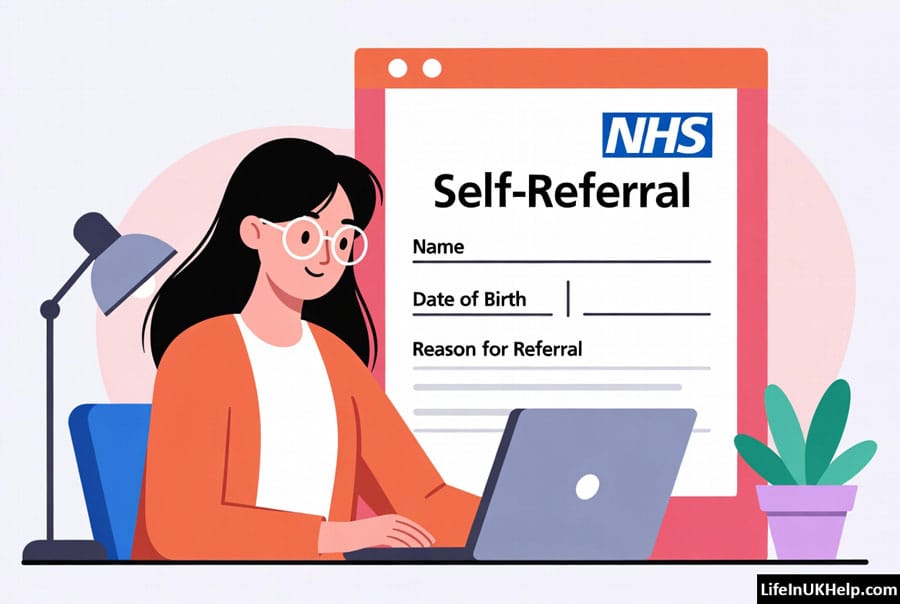
Many people think you need a GP to get therapy on the NHS. That is not always true. In England, you can often refer yourself directly to free mental health support, without waiting for a doctor.
This article is for anyone living in the UK who is struggling with anxiety, low mood or stress and is not sure where to start. It is especially useful for new arrivals and immigrants who may not have a GP yet.
The short answer: yes, in most parts of England, you can self-refer to NHS Talking Therapies without seeing a GP first.
New to the UK? Check out our Living in the UK Guide to see the full picture.
Table of Contents
| ℹ️ What is NHS Talking Therapies? NHS Talking Therapies (previously called IAPT — Improving Access to Psychological Therapies) is a free NHS service in England. It helps adults aged 18+ who have mild to moderate: – Anxiety or worry – Depression or low mood – Panic attacks – Phobias or OCD – Post-traumatic stress (PTSD) It offers evidence-based therapies such as CBT (Cognitive Behavioural Therapy) guided self-help and counselling. |
Why People Search for This Topic
People who need mental health support often run into the same wall: they want help, but they don’t know how to access it without a GP. These are the most common reasons:
- They are not yet registered with a GP
- They feel uncomfortable talking to a doctor about mental health
- They do not know free therapy even exists
- They are worried their immigration status will be a problem
- They have tried to get a GP appointment and waited too long
These worries are very common. This article answers all of them clearly.
Short Answer
| ✅ Yes, you can self-refer in most of England – No GP appointment needed in most areas – The service is called NHS Talking Therapies – It is completely free on the NHS – Available to people ordinarily resident in England (including many immigrants & visa holders) – Enter your UK postcode to find your local service (some may also ask for GP details) – Self-refer online, phone, or email |
Explanation
NHS Talking Therapies is a government-funded service that provides free, professional talking therapy to adults in England. You do not need to pay anything. You do not need to see a private doctor.
The word “self-referral” simply means: you contact the service yourself. You do not need your GP to send a letter or make the call for you. Most local NHS Talking Therapies services have an online form you can fill in or a phone number you can call directly.
This is the NHS’s official route to mental health support for common conditions. It is not a charity, not a private service and not a waiting-list workaround. It is designed to be easy to access.
Step by Step: How to Refer Yourself to NHS Therapy
| 1- Go to the NHS website: Visit nhs.uk and search “NHS Talking Therapies”or go to Find NHS Talking therapies: 2- Enter your postcode: The website will show the Talking Therapies service that covers your area 3- Fill in the self-referral form: Most services have an online form. Some also accept phone or email referrals. The form asks about your mood, sleep and daily life 4- Wait for a call: The service will contact you, usually within a few weeks, for a short phone assessment (around 30 minutes) 5- Start therapy: Based on the assessment, you will be offered the most suitable type of therapy. Sessions may be by phone, video call or in person |
A Real-Life Example
| “Sam moved from Iran to Manchester eight months ago. He has been feeling very anxious and cannot sleep. He does not have a GP yet and is worried his visa status will stop him from getting help. He goes to nhs.uk, types in his postcode and finds his local NHS Talking Therapies service. He fills in the online form. Two weeks later, a therapist calls him for an assessment. Six weeks after that, he starts weekly CBT sessions by video call. He paid nothing. He never needed a GP and He did not need to show proof of immigration status during the process. |
Important Things to Know
| 🌍 Does immigration status matter? NHS Talking Therapies is available to people who are ordinarily resident in England, including many visa holders, asylum seekers and people on temporary leave. |
Quick Facts
| Who can use it? | Adults aged 18+ living in England |
| Cost | Free, paid for by the NHS |
| Waiting time | Varies by area. Often 2-12 weeks |
| Where available? | England only. Scotland, Wales and N. Ireland have different services |
| Session format | Phone, video call or in-person |
Tips and Warnings
| 💡 Helpful tips – Do not wait until you are in crisis: Self-refer as soon as you feel you need support. Earlier is better. – Language support: If English is not your first language, ask the service about interpreters. Many can help. – Be honest on the form: The referral form asks about your symptoms. Honest answers help them offer you the right therapy. – Keep the appointment: If you miss your assessment call, contact them to reschedule. Missed appointments can remove you from the waiting list. |
| ⚠️Important warnings – NHS Talking Therapies is for mild to moderate conditions only. If you are in a mental health crisis, call 999 or 111. – Do not pay anyone to refer you. Self-referral is free. There are fake websites that charge for this. – Always use nhs.uk. Do not search for local services on unofficial websites. |
| 🚨 If you are in crisis right now, DO NOT use this service NHS Talking Therapies is not for emergencies. If you are in crisis or having thoughts of suicide: – Call 999 if you are in immediate danger – Call 111 and select the mental health option – Call Samaritans free on 116 123 (24 hours, 7 days) – Go to your nearest A&E |
Official Information Source
Find your local NHS Talking Therapies service and self-refer through the official NHS website: NHS Talking Therapies
(FAQ)
Q1: Do I need to be registered with a GP to self-refer?
Not usually. Most NHS Talking Therapies services only ask for your postcode, not your GP’s name. However, a small number of local services do ask you to be GP-registered. If this happens, contact the service and explain your situation, they may still accept you. You can also register with a GP at any time using the NHS website, even if you have no fixed address.
Q2: Will my visa or immigration status affect my access?
In most cases, no. NHS Talking Therapies is a primary care service available to people ordinarily resident in England. This includes many visa holders, asylum seekers and people on temporary leave. You are not usually asked to prove your immigration status when self-referring. However, the rules are complex. If you are unsure, contact a local advice service such as Citizens Advice or Migrant Help.
Q3: How long will I wait for therapy?
Waiting times vary a lot depending on where you live. In some areas, you may start therapy within 2-4 weeks. In others, it can take 3-6 months. After you self-refer, the service aims to contact you for an initial assessment within 6 weeks. You can ask the service for their current waiting time when you call or submit your form.
Q4: What if self-referral is not available in my area?
A small number of areas in England still require a GP referral. If this is the case for your postcode, you have two options:
A- Register with a local GP and ask them to refer you, they cannot refuse if you meet the criteria.
B- Contact the service directly and ask if they will make an exception. Some will, especially if you explain you do not yet have a GP.
Q5: Can I self-refer if I am already seeing a private therapist?
Yes. Seeing a private therapist does not stop you from self-referring to NHS Talking Therapies. The NHS service is separate. However, the service may ask about your current support during the assessment and in some cases they may recommend you continue with your existing therapist rather than offering a duplicate service.
Conclusion
Key takeaways:
If you are not sure whether the service is right for your situation, call your local NHS Talking Therapies team and ask. They are used to answering these questions and will guide you.
Getting help is not a sign of weakness. It is a practical step, just like calling a GP for a physical problem. You deserve support and you do not need anyone’s permission to ask for it.
Related Articles on ”Life in UK Help”
- How to Register with a GP in UK: 5 Easy Steps
- When to Call 999 in the UK: NHS Emergency Guide
- How NHS Referrals and Waiting Lists Work in the UK
Have a question in mind?
Post it in the comments. I will reply and share the answer with everyone. For personal queries, please reach me via my Contact page.
Hi. What if I was refused or discharged? Can I re-refer myself?
Hi My friend,
And yes. If you were previously discharged from NHS Talking Therapies (for example, because you missed appointments or your symptoms improved) you can self-refer again at any time. There is no rule that prevents re-referral. Simply go to nhs.uk and submit a new self-referral form. Be open in the form about your previous experience,this helps the service understand your needs.
Be safe