


💡 Can I get student finance as an immigrant in the UK?
If you have pre-settled status and you are thinking about going to university, chances are one of the first things on your mind is money. Can you actually access student finance, or will you end up paying international fees? The answer depends mainly on how long you have been in the UK, not just what your immigration status says.
Note: This guide covers England and Student Finance England. Rules can change depending on UK immigration and education policy updates, so always check GOV.UK for the latest information.
If you are new to the UK, check out our Living in the UK Guide to see the full picture.
Why People Search for This Topic
Pre-settled status sits in an awkward middle ground. You are legally in the UK, you are working or building a life here, but the system does not always make it obvious whether you are treated the same as someone with settled status or whether you end up paying overseas fees that can be two or three times higher.
A lot of people assume the worst and never apply. Others apply without understanding the residency rules and get refused. Both happen more often than they should, and usually the situation is more manageable than it first appears.
The Short Answer
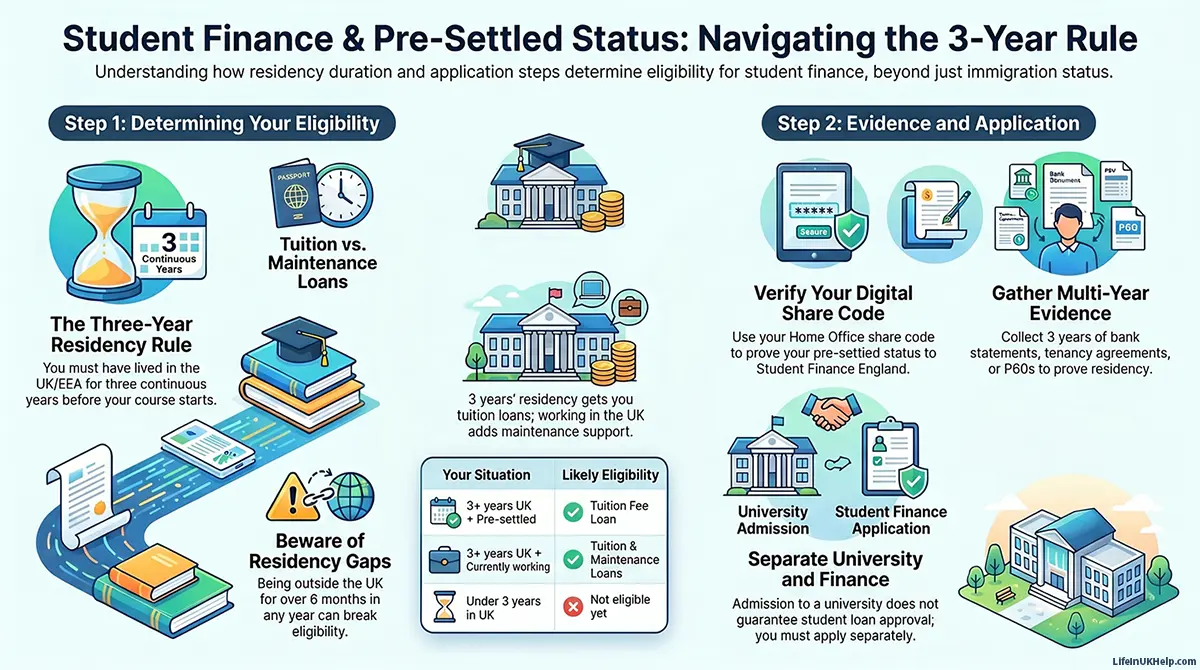
Pre-settled status alone does not automatically get you student finance. What matters is how long you have been here:
- You need to have lived in the UK for at least three years before your course starts.
- If you meet the three-year rule, you are likely to qualify for a tuition fee loan.
- Whether you also get a maintenance loan (living costs) depends on whether you are working or have worked in the UK.
- The three years can sometimes include time in the EEA or Switzerland, not just the UK.
- Non-EU nationals with pre-settled status follow different rules, this guide focuses mainly on EU, EEA and Swiss nationals.
What Is Pre-Settled Status?
Pre-settled status comes from the EU Settlement Scheme. It is given to EU, EEA and Swiss nationals who were living in the UK before the end of 2020 but had not yet been here for five continuous years when they applied.
Once you reach five continuous years, you can apply to upgrade to settled status, which has no time limit. The distinction matters for student finance because settled status is treated more like indefinite leave to remain, the rules are clearer. Pre-settled status is more complicated, and eligibility comes down to how long you have actually been in the country.
Can I Get Student Finance With Pre-Settled Status?
Yes, in many situations, but the three-year residency requirement is the deciding factor, not the status itself.
EU nationals with pre-settled status are generally eligible for a tuition fee loan after three years of residence in the UK, EEA or Switzerland. For a maintenance loan, the money that helps with rent and living costs, you usually also need to show that you are working or have worked in the UK. Student Finance England will ask for a P60 or a letter from your employer as evidence.
| Situation | What This Usually Means |
|---|---|
| Three years in UK + pre-settled status | Likely eligible for tuition fee loan |
| Three years + working in UK | Likely eligible for tuition fee and maintenance loan |
| Less than three years in UK | Not eligible yet |
| Pre-settled status but no residency evidence | Application likely refused |
| Family member of EU national with pre-settled status | May be eligible / check separately |
When Applications Get Refused
Most refusals are not because someone did something wrong. They tend to happen for a few predictable reasons:
- Not enough years in the UK. If you arrived less than three years before your course starts, the residency requirement is simply not met yet.
- Gaps in continuous residence. If you were away from the UK for more than six months in any 12-month period, it can break your continuous residence record and affect eligibility.
- Wrong visa type. Pre-settled status under the EU Settlement Scheme is specific to EU, EEA and Swiss nationals. Other types of leave to remain follow completely different rules.
One thing that catches people off guard: the university and Student Finance England make their decisions separately. A university might give you home fee status, but that does not guarantee you will get a student loan. Student Finance England has its own rules and no discretion to bend them.
Common Mistakes to Avoid
- Applying before you have three years of residency, assuming pre-settled status is enough on its own.
- Treating university admission and student finance as the same process. They are not,you need to apply for each separately and the eligibility criteria are different.
- Not keeping records of your time in the UK. If your residency is ever questioned, having bank statements, tenancy agreements or payslips going back three years makes a big difference.
- Assuming a refusal is final. If you are refused, you have the right to appeal. Ask Student Finance England to explain the decision in writing and go from there.
Example
👤 Sam’s situation
Sam is Persian and came to the UK in 2021. He was granted pre-settled status and has been working since he arrived. In 2024, three years after arriving, he decides to study nursing. He checks his eligibility on GOV.UK, confirms he meets the three-year residency requirement and applies to Student Finance England. He provides his share code as proof of status, his passport, and a P60 from his employer. He is approved for both a tuition fee loan and a maintenance loan and starts his course paying home fees that September.
What Documents You Will Need
When you apply to Student Finance England, you will typically need to provide:
- Your digital share code as proof of pre-settled status
- Proof of identity / usually a passport or national identity card
- Evidence of three years of residence: this could be payslips, tenancy agreements, bank statements, or letters from employers or official bodies
- If applying for a maintenance loan: a P60 or letter from your employer confirming you are working or have worked in the UK
🔍 Tip: gather your documents before you apply. Student Finance England can ask for evidence at any point in the process. Having your residency documents ready from the start tends to make things go much more smoothly.
Step by Step: How to Check and Apply
- Use the student finance eligibility tool on GOV.UK (gov.uk/student-finance). It takes a few minutes and gives you a clearer picture of your situation before you commit to applying.
- Gather your residency evidence. Go back three years and collect anything official that shows you were living in the UK: payslips, tenancy agreements, bank statements, council letters.
- Apply to Student Finance England via the student finance portal. You will need to create an account if you do not already have one.
- Provide your share code when asked. This is how Student Finance England verifies your pre-settled status directly with the Home Office.
- If you are applying for a maintenance loan and you are working, upload your P60 or employer letter at the same time. This avoids delays later.
- Wait for a decision. If approved, your loan is paid directly to your university (tuition fee loan) or to your bank account in three instalments during the academic year.
What to Do If You Are Not Eligible Yet
If you have not yet reached three years of residency, there are still options worth thinking about:
- Wait until you meet the three-year requirement before starting your course. Delaying by a year can make a significant financial difference.
- Talk to the university’s student welfare or finance team. Some universities have bursaries or hardship funds for students in this situation.
- Look into degree apprenticeships. Your employer covers the tuition fees, you earn a salary, and there is no loan involved.
- Check whether any scholarships or grants apply to your situation. UKCISA (ukcisa.org.uk) has useful guidance for migrant and international students in the UK.
Tips and Warnings
- Do not assume pre-settled status is enough on its own. The three-year residency rule is what Student Finance England actually looks at.
- Use the GOV.UK eligibility checker before applying. It is free and takes a few minutes. Far better to know your position in advance.
- Keep all records of your time in the UK. Bank statements, payslips, tenancy agreements, anything that shows you were here. If residency is ever questioned, these documents are your evidence.
- If your application is refused, ask for the reason in writing. You have the right to appeal and many refusals are overturned when the right evidence is provided.
- Remember that student finance is paid in three instalments, September, January and April. There is nothing in the summer. Budget for that gap from the start.
Official Information Sources
- Student finance eligibility on GOV.UK
- Guidance for international and migrant students
- EU Settlement Scheme information
Frequently Asked Questions (FAQ)
Does pre-settled status automatically qualify me for student finance?
No, sorry. it is only part of the picture. You also need to meet the residence rules, which usually means three years of ordinary residence in the UK before the first day of your first academic year. Status alone is not enough.
Can time I spent in another EU country count towards the three years?
In some specific cases, yes. Certain EEA or Swiss workers with pre-settled status may be able to count time spent in the UK, Gibraltar, the EEA, or Switzerland, but only if that time was not mainly for the purpose of studying. This does not apply to everyone, so check your individual situation carefully.
What happens if my immigration status changes while I am already studying?
If your status changes during your course for example, you upgrade from pre-settled to settled status Student Finance England may reassess what support you are entitled to going forward. It is worth letting them know as soon as your status changes.
My university charged me home fees. Does that mean I will get a student loan?
Not necessarily. Universities and Student Finance England assess your situation separately and can reach different conclusions. Being charged home fees is a good sign, but it does not guarantee you will receive a loan.
Will time spent abroad affect my eligibility?
It depends on the circumstances, there is no single rule that applies to every case. Extended absences can affect your eligibility, but Student Finance England looks at the full picture: why you were away, for how long, and whether you kept your home in the UK. If you have spent time abroad, it is worth getting advice before you apply.
Conclusion
Three years in the UK with your documents ready? You probably qualify. A lot of people never find out because they assume the answer is no before they even look it up.
Check your eligibility on GOV.UK first. If something is not clear, call Student Finance England or walk into your university’s student support office. They deal with exactly these questions every day. You will not be the first person to sit across from them with this situation and you will not be the last.
Related Articles
- How to Study at University in the UK as an Immigrant
- How to Get a Job in the UK Without UK Experience
- How to Choose the Right Primary School in the UK
Still have questions?
Drop them in the comments section. I reply to every comment. If it’s something private, just send me a message through the Contact page.