

Introduction
You are ready for work. You have made plans around your shift. Then your employer sends a message: your shift is cancelled. No reason. No warning. This happens to a lot of workers on zero-hours contracts in the UK and it can feel like there is nothing you can do about it.
There is. This article explains your rights in simple English and tells you exactly what to do next.
New to the UK? Check out our Living in the UK Guide to see the full picture.
Quick Answer: Your Rights at a Glance
Yes, your employer can cancel your shift. But not always without consequences. Here are the key rules:
- If your contract includes a notice period, your employer must follow it.
- If your contract says nothing, they can cancel at short notice.
- If you arrive at work and are sent home, you may still be entitled to pay-check for a “show-up pay” clause.
- They cannot cancel shifts because of your nationality, religion or other protected characteristics.
- They cannot reduce your hours to punish you for complaining. This is called “detriment” and it is unlawful.
Your contract is your most important document. Always check it first.
“I Have No Rights on a Zero-Hours Contract”-Why This Is Wrong
Many workers believe this: “I am on a zero-hours contract, so my employer can do anything they want.” This is NOT true. You do have rights. The level of those rights depends on your employment status and most people on zero-hours contracts are classified as workers, not employees. That still means real, legal protection
Worker vs Employee on a Zero-Hours Contract
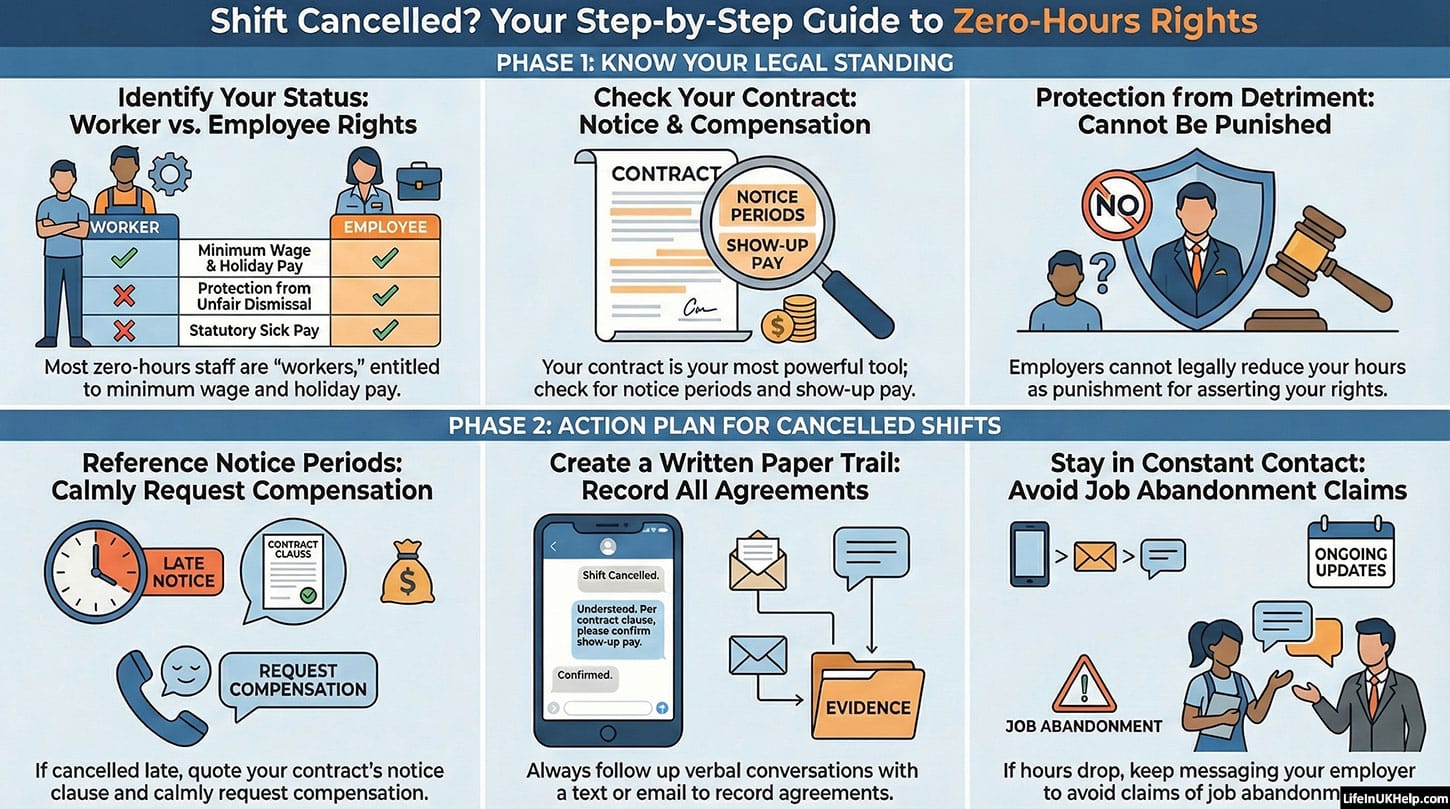
Most people on zero-hours contracts are workers. Here is what the difference means for you in practice:
| Worker | Employee |
|---|---|
| Minimum wage + holiday pay | All worker rights PLUS more |
| Right to a payslip | Protection from unfair dismissal |
| Cannot be penalised for asserting rights | Statutory sick pay |
Even as a worker, the most common status on a zero-hours contract, you are protected by law. Your employer cannot simply ignore those protections.
Example: Shift Cancelled with No Notice
Sam works in a restaurant on a zero-hours contract. His shift starts at 6pm on Saturday. At 4pm, his manager sends a WhatsApp message: “Sorry, it is quiet tonight. No need to come in.”
Sam is already dressed for work. He was counting on that money. He opens his contract and finds this clause: “The company will give workers at least 24 hours’ notice if a shift is no longer required.” Two hours is not 24 hours.
He replies to his manager calmly, points out the notice clause and asks for compensation. The manager agrees to pay his for two hours.
The lesson: Your contract gives you real power, but only if you read it and use it.
Always Keep Your Messages Written
If you speak to your manager in person or by phone, always follow up with a written message straight away. Something like: “Just to confirm what we discussed today…” This creates a record you can use as evidence later if needed.
✅ Tip: Written messages protect you
Email or WhatsApp are both fine. The important thing is to have a written record of what was agreed. Do not rely on verbal promises.
When Your Employer Slowly Takes Away Your Hours
Sometimes the problem is not a single cancelled shift. Your employer simply stops offering you shifts, one by one, until your hours drop to zero. They never officially end your contract. They just make you disappear.
This is more common than people realise and it often happens after a worker complains or asks about their rights.
How to Protect Your Rights If Hours Are Reduced
- If your hours dropped after you raised a complaint, this may be unlawful detriment. You may be able to make a claim.
- If hours dropped for genuine business reasons, it is harder to challenge but ask for a written explanation.
- Stay in contact with your employer even when you are not being given shifts. Going silent can work against you.
- Keep a written record of every time you were offered or not offered a shift.
⚠️ Warning: Do not just disappear
If you stop receiving hours and you stop responding to your employer, they may claim you abandoned the job. This can affect your work record and make it harder to get a reference. Always stay in contact, even if only by message.
Are Zero-Hours Rules Getting Stronger in 2027?
Yes. The Employment Rights Act 2025 will improve protections for zero-hours workers. When it comes into force, employers will need to offer a guaranteed minimum number of hours to workers who work regularly. There will also be stronger rules around compensation for last-minute cancellations.
However, these changes are not in force yet. They are expected to apply from 2027.
Zero-Hours Rights Guide
Official Information Source
For official guidance on your rights at work and zero-hours contracts, visit:
- Official guidance on worker employment status – GOV.UK
- Acas guidance on zero-hours contracts and worker rights
What to Do After Your Shift Is Cancelled
If your employer cancels your shift at the last minute, it does not always mean they are allowed to do it. Check your contract. Record everything. Follow up in writing. And if your employer refuses to engage, contact Acas, they are free, independent and they help thousands of workers in the UK every year.
You do not have to accept it. You do not have to deal with it alone.
Remember: a zero-hours contract is not the same as having no rights. You have rights. Now you know what they are, use them.
Frequently Asked Questions (FAQ)
1. Can my employer give me zero hours one week and then expect me to be available the next?
Yes, they can, if your contract allows it. But if you are always available and they still never give you shifts, you do not have to just accept it. Ask your employer to put a notice period in writing. This means they must tell you in advance if a shift is cancelled. Without anything in writing, it is much harder to challenge them later.
2. Do I still earn holiday pay if I only worked a few hours this month?
Yes. You start earning holiday pay from the very first hour you work even on a zero-hours contract. Many workers do not know this and never ask for it. Check your payslip every month. If you cannot see holiday pay, write to your employer and ask. This is your legal right and they cannot take it away.
3. Can I work for two employers at the same time on a zero-hours contract?
In most cases, yes. Since 2015, exclusivity clauses in zero-hours contracts are not allowed in the UK. This means your employer cannot legally stop you from working for someone else. However, be aware: if your employer finds out you work elsewhere, they may simply offer you fewer shifts. They cannot punish you officially, but in practice, it can happen. Keep records if you notice your hours dropping after you start a second job.
4. Does my employer have to give me a written contract on zero hours?
Yes. Since April 2020, your employer must give you a written statement of your main terms from your very first day of work. A second, more detailed statement must follow within two months. Many workers never ask for this and some employers do not give it automatically. If you have not received anything in writing, ask for it now. Without it, it is much harder to challenge a cancelled shift or unfair treatment.
More Guides on Life in UK Help
- How to Get a Job in the UK Without UK Experience (12 Steps)
- 10 Essential UK Laws Newcomers Don’t Know About
- Working in the UK Without a Contract: Your Rights, Risks & What to Do
Not sure about something?
Ask your question in the comments! I check them regularly and answer so others benefit as well. For private inquiries, you can always use my Contact page.
Hi
If my shift gets cancelled while I’m already on my way in do I still get paid for the travel? Thanks
Hi my friend,
Your employer doesn’t have to pay your travel costs by law. But check your contract, some contracts include a (show-up pay) clause. This means you get a minimum payment if your shift is cancelled at short notice, even if you were already on your way.
If your contract doesn’t mention this, it will be difficult to get the money back. It’s still worth asking your manager nicely, they may help you as a one-off.