


Introduction
Moving to the UK can be exciting, but also challenging, especially when laws differ from your home country. The UK legal system prioritises equality, individual rights, and the rule of law. Some rules may surprise newcomers.
Many don’t realise breaking UK laws can lead to fines, criminal records, imprisonment or immigration issues. A criminal record can also seriously affect your right to work, DBS checks, and future visa or settlement applications. These mistakes often happen unintentionally, simply because the system works differently here.
This article reveals 10 UK laws newcomers don’t know about, with real-life examples and practical advice for England & Wales. Master these rules to stay safe, avoid trouble and settle confidently.
New to the UK? Check out our Living in the UK Guide to see the full picture.
1. Polygamy (Multiple Marriages in the UK)
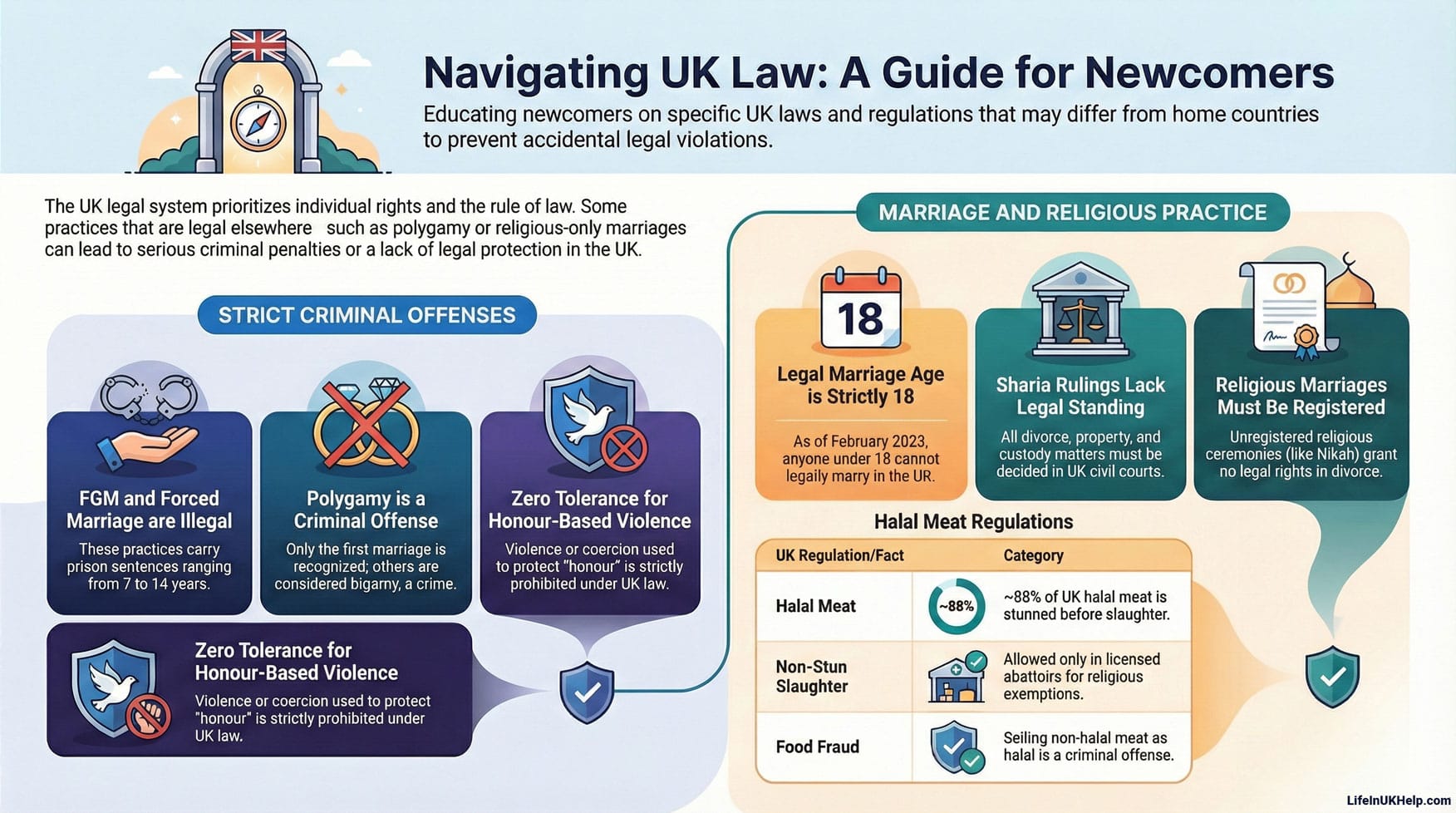
In the UK, you can only be legally married to one person. Even if polygamy is allowed in your home country, only the first marriage is legally recognised. Any additional marriages will be considered bigamy which is a criminal offense.
Punishment: Up to 7 years in prison.
2. Forced Marriage Laws in the UK
Forced marriage is illegal in the UK. This includes not only situations where a person is physically coerced into marriage but also emotional or psychological pressure. Arranging a marriage for someone under 18 is also a crime. Additionally, taking someone abroad to force them into marriage is prohibited.
Punishment: Up to 7 years in prison.
3. Female Genital Mutilation (FGM) Laws in UK
Female Genital Mutilation (FGM) is the act of cutting or altering a girl’s or woman’s genitalia for cultural or religious reasons. In the UK, this practice is a serious crime and considered a form of child abuse, regardless of where it is carried out (even if done outside the UK).
Punishment: Up to 14 years in prison.
Did you know?
Arranging a marriage for someone under 18 is a criminal offence in England and Wales, even if there is no force. Also, Sharia divorce certificates are not legally recognised by UK courts.
4. Honour-Based Violence in UK
Honour-based violence, including physical violence or murder carried out to protect a family’s “honour,” is illegal in the UK. This can include violence due to a person’s relationships, clothing choices, or sexual orientation. Rape in marriage is also illegal.
Punishment: Varies based on the severity of the crime.
5. Child Marriage and Age of Consent in England & Wales
The legal age for marriage in England and Wales is now strictly 18 (as of February 2023). The age of sexual consent remains 16. Any marriage involving someone under 18 is not valid in the UK, even if considered legal in your home country.
6. Sharia Law in UK Courts
Sharia law may be practiced in some communities for religious matters like divorce or family disputes, but it has no legal standing in UK courts. All matters of divorce, property rights and child custody must be decided according to UK civil law.
Important to Know: UK courts do not recognise Sharia councils’ rulings.
7. Unregistered Religious Marriages in UK
An Islamic marriage (nikah) is a religious ceremony, but for it to be legally valid in the UK, it must be registered with a civil authority. If it’s not registered, the couple has no legal rights in the event of divorce, such as property rights or financial support.
Important to Know: Unregistered Nikah = legally considered cohabitation, not marriage.
Always register a nikah with the civil authorities for legal recognition.
8. Illegal Immigration & Asylum Rules in UK
Coming to the UK without the proper authorisation (such as crossing the sea in an unapproved manner) is illegal. Immigration laws are strict and breaking them can lead to arrest, denial of asylum and deportation.
Important to Know: Under the Illegal Migration Act 2023, many people who enter the UK irregularly will not have their asylum claims considered and may be refused refugee status or other permission to stay, except in limited circumstances.
9. Religious Dress and Extremism Laws in UK
While wearing religious clothing such as hijabs or niqabs is allowed in the UK, there are certain places like airports or courts where you may need to remove your face veil for security reasons. Furthermore, peaceful advocacy for Sharia law or religious expression is not illegal unless it incites violence, hate or extremism.
Important to Know: The Public Order Act and Terrorism Act make it a crime to incite violence, terrorism or hate crimes. Advocacy or peaceful expression of religious beliefs is legal as long as it does not cross these boundaries.
10. Halal Slaughter and Animal Welfare Regulations in UK
UK law generally requires stunning before slaughter, but religious exemption allows non-stun halal/kosher slaughter in licensed abattoirs by certified personnel.
Key facts:
- ~88% UK halal meat is stunned (accepted by many Muslim scholars)
- All kosher meat is non-stunned
- Must follow strict hygiene/welfare standards
- Selling non-halal as halal = criminal food fraud.
Important: Halal slaughter is legal. Ask suppliers about stunning if it matters to you.
Frequently Asked Questions (FAQ)
1. Can polygamous marriages affect my UK visa?
Yes. Under UK immigration rules, only one spouse can qualify for a partner or spouse visa. Even if a polygamous marriage is legal in your home country, additional spouses are not eligible for UK family visas.
2. Is it legal to take a child abroad for FGM or early marriage?
No. The UK has extraterritorial laws, meaning these acts are illegal even if done outside the country.
FGM: Up to 14 years in prison
Forced or child marriage: Up to 7 years in prison Arranging travel for these purposes is also a criminal offence.
3. Do Sharia councils have legal authority over UK family courts?
No. Sharia councils do not have legal power in the UK. Only civil courts can make binding decisions on marriage, divorce, finances, and child arrangements. Unregistered nikah ceremonies usually give no legal marriage rights.
4. Can I wear religious clothing or symbols at work or school?
Yes, unless it conflicts with health/safety (e.g. loose niqabs near machinery) or uniform policies upheld by courts. Bans in specific public roles like courtroom witnesses apply for ID verification.
5. Does applying for asylum guarantee family reunion?
No. Family reunion rules only cover your immediate family (partner and children under 18 who were part of your household before you fled). Extended family members are rarely accepted. Applications can take many months due to backlogs.
Conclusion
The UK has many laws that may be very different from those in other countries. Being aware of these rules is essential for avoiding serious legal trouble and living safely and confidently in the UK.
Following the law helps ensure your rights are protected and allows you to enjoy life in your new country without unnecessary risks. If you have any doubts or questions about UK laws, always refer to official government resources or seek professional legal advice.
Related Articles
- Working in the UK Without a Contract
- How to Get a Job in the UK Without UK Experience
- Your First UK Payslip
Have a question in mind?
Post it in the comments. I will reply and share the answer with everyone. For personal queries, please reach me via my Contact page.